
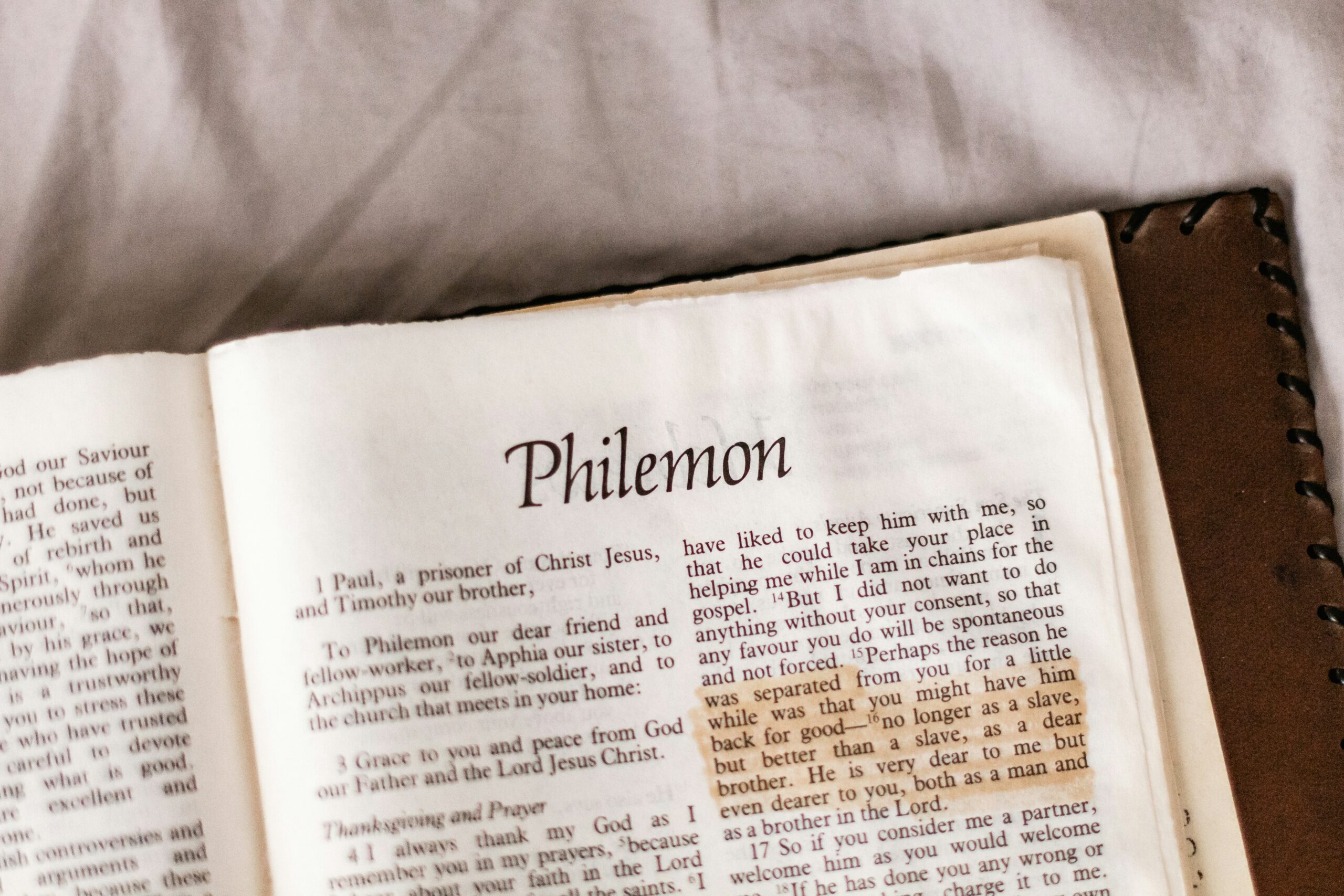
What is the book of Philemon?
The biblical book of Philemon is a personal letter from Paul the Apostle to one of his friends, Philemon. In it, Paul intervenes on behalf of Onesimus, Philemon’s runaway slave that was somehow led to the Lord by Paul while in prison (v. 10): receive him back as a brother (v. 16,17), and even “go beyond” what he asks (v. 21). This letter, however, is not merely a personal letter that somehow made it into our canon of Scripture. Instead, it deeply shows our love and acceptance by the Father on behalf of someone else, Jesus Christ.
Who is Philemon in the Bible?
Philemon is apparently very well off: the church in Colossae meets in his home (v. 2). He has slaves (v. 16): an uncomfortable truth for us, but an economic fact in Rome’s existence (in fact, this will shape the direction of Paul’s letter). When Onesimus ran away, he probably stole from Philemon (v. 8-19). He also has enough room in his home that Paul can expect a place to stay when he soon visits (v. 22).
Philemon is a Christian, apparently led to the Lord by Paul (v. 19: we could interpret this as Paul having saved Philemon’s physical life, but more naturally it’s his spiritual life). He’s counted as Paul’s friend and co-worker (v. 1,6), whom Paul constantly prays and thanks God for (v. 4). As an apostle, Paul could command Philemon (v.8), but instead is confident enough to appeal on the basis of love (v. 9,21). Philemon is known for his love and compassion towards all of God’s people (v. 5,6,7,20).
What is the Apostle Paul’s appeal to Philemon?
This characteristic of love and compassion forms the basis of Paul’s appeal: “Philemon, you’ve shown such love and compassion towards me and all of God’s people…can you show it towards another? Someone who has wronged you? Can you ‘refresh my heart’ and show compassion towards Onesimus?” (v. 10,20)
This request from Paul the Apostle (v. 1,8), Paul the prisoner of Christ (v. 1,9,10,13,23), Paul the Aged (v. 9), and Paul, his friend and father in the faith (v. 1,17,19,20) puts Philemon in a quandary. Roman law says to deal with a runaway slave in a certain way. Philemon’s Christian compassion tells him to deal with Onesimus in a different way. Will Philemon be a “right Roman” or a “compassionate Christian”? Philemon’s new Christian worldview is coming up against his cultural norms: which one will change?
What is the purpose of this epistle written to Philemon?
This letter is not merely a letter showing how Christian compassion works and grows. We can instead substitute Jesus Christ, the Father, and ourselves as the characters in the story and see a picture of how our acceptance in Christ works. Paul asks that all of Onesimus’ “demerit” be placed on his account, and he would pay it (v. 18,19). At the same time, Paul asks that all the favor that Philemon has for him be directed towards Onesimus (v. 17). Think of this: Paul, who has done everything right (for Christ and for Philemon), takes his merit and gives it to Onesimus, who has done nothing right.
This is what Jesus does for us: “Take all of Chris’ sin and place it on Me; I will pay it all. Take all of My righteousness and place it on Chris and receive him as You’d receive Me.” The picture is presented here in Philemon; this doctrine of “double imputation” is laid out in Colossians 2.13-14; 2 Corinthians 5.21; etc.: my sins are placed on Christ, and His righteousness is placed on me.
We have no concrete idea how Philemon responded, and whether or not Onesimus was received (or in what manner), though there may be some extra-biblical sources that shed some light. God, however, tells us clearly that we are forgiven of all our sins and Christ’s righteousness is attributed to our account before Him!
Are you interested in growing your knowledge of God’s word?
At Ethnos360 Bible Institute, students are walked through the Bible chronologically. They learn more about the background, context, and purpose of each book in the Bible. Click below to receive more information!